Have one, keep it separate, connect it
Which bank matters far less than most people think. What matters is that the business has its own account and that it feeds your bookkeeping every day. Here is why, and what to look for.
- A daily feed into your accounting software
- Free, or clear about what the fee buys
- Cash and cheques, if you take them
- Pots to hold the VAT and the tax
- A human when a payment fails
- An account you can open without us
Keeping the business money separate
If you trade through a limited company, the company's money is not yours. Paying for the weekly shop out of the company account is a director's loan whether you meant it that way or not, and a year of doing it is a year of untangling at your cost.
If you are a sole trader you may legally use a personal account, and it is still the wrong idea. Mixed transactions mean every line has to be judged rather than coded, which is slower, more expensive and less accurate, and it makes an HMRC enquiry into a much longer conversation than it needed to be.
So the first thing worth saying about business banking is not which bank. It is: have one, keep it separate, and connect it.
Five things, in this order
- 1A working feed into your accounting software
The single most important feature and the one nobody markets on. A daily read-only feed is what makes the books current; a bank that requires you to download statements adds a manual step every month, for ever.
- 2Free, or nearly
Plenty of business accounts are free for small businesses. Paying a monthly fee is fine if you get something for it, and worth questioning if you cannot say what.
- 3Cash and cheques, if you take them
A lot of app-based accounts handle cash badly or not at all. If you take takings over a counter, check this before anything else.
- 4Sub-accounts or pots
Being able to move the VAT and the corporation tax out of the current account as it is earned is the single most effective cash discipline there is for a small business. It costs nothing.
- 5Getting hold of a human
It matters on the day a payment fails or an account is frozen, and not before.
Mettle, by NatWest
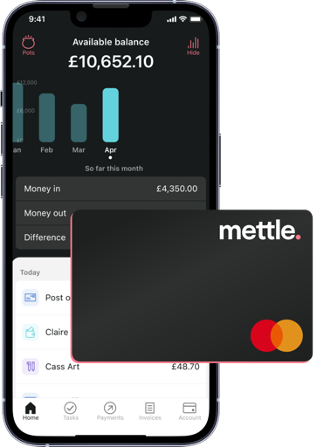
Buzz is not paid by Mettle and has no commercial arrangement with them. We are asked about business accounts often enough that it is worth setting out what we think of this one.
What we would say for it on the merits: it is free to open and free to run, it was built for sole traders and small companies rather than adapted down from a corporate product, it feeds cleanly into the accounting software, and a Mettle account gets you FreeAgent free for as long as you make at least one transaction a month — which is £330 a year plus VAT you would otherwise pay. Eligible deposits are protected up to £85,000 by the Financial Services Compensation Scheme.
What we would say against it: the eligibility rules are narrow. Sole traders, and limited companies with up to two owners, UK-based, owners UK tax resident, balance limit £1 million. Three or more shareholders, most partnerships and any overseas ownership are out, and it is worth checking that before you spend time on an application.
Banking elsewhere changes nothing
Nothing in your accountancy service depends on where you bank, and nobody at Buzz will chase you about it. We work with whatever account you have, and the only practical requirement is a reliable feed into the software.
If you do not fit the criteria — three shareholders, a partnership, overseas ownership, a lot of cash across the counter — tell us what the business actually does and we will talk about what works. That conversation costs nothing and we are not paid for the answer.
What people ask about business banking
Do I legally need a business bank account?
A limited company does in practice, because the company is a separate legal person and its money is not yours — taking it out informally creates a director's loan with a possible 33.75% s.455 charge attached. A sole trader does not legally need one, and should still have one, because mixed transactions make the bookkeeping slower, dearer and less accurate.
Who is eligible for the Mettle account?
Sole traders, and limited companies with up to two owners, where the business is UK-based and the owners are UK tax residents, with a balance limit of up to £1 million. That rules out companies with three or more shareholders, most partnerships and businesses with overseas ownership.
Do I have to bank with Mettle to be a Buzz client?
No, and nothing in your service depends on it. If your current bank has a reliable feed into your accounting software, there is no reason to move.
Does Buzz get paid if I open an account?
No. Buzz has no commercial arrangement with Mettle or any other bank, and receives nothing if you open an account. The case for the account on the merits is above, alongside the case against.
Is my money safe?
Eligible deposits are protected up to £85,000 by the Financial Services Compensation Scheme, the same protection that applies at any UK-authorised bank. If you routinely hold more than that, spreading it across institutions is the standard answer and worth a conversation.
What about a savings account for the tax?
Worth doing, and the discipline matters more than the rate. Moving the VAT and corporation tax out of the current account as it is earned is the most reliable way we know of never being short on a payment date.